Commission-free ordering vs marketplace fees
If you sell a $40 meal online, the real question is not revenue. It is how much you keep after variable costs.
This guide breaks down marketplace-style fee economics versus commission-free direct ordering, then gives you a practical transition plan to move repeat guests into your owned channel.
- Compare channels using contribution margin, not vanity metrics.
- Keep marketplaces for discovery, but prioritize direct ordering for retention.
- Build a repeat engine with loyalty + CRM tied to real orders.
How marketplace fees reduce restaurant profit
Fee structures vary by provider, market, and program tier. But the common pattern is the same: percentage-based fees scale with every order, which can turn your best-selling items into your lowest-margin tickets.
Beyond the fee itself, marketplaces often control the guest relationship, making it harder to build repeat behavior that belongs to your brand.
- Percentage-based commissions or service fees (often the biggest line item).
- Marketing or promotional costs tied to visibility and discounts.
- Refunds, chargebacks, and operational friction that increase with off-premise volume.
- Guest ownership loss when reorders happen inside the marketplace, not your channels.
A simple framework: contribution margin per digital order
To compare channels fairly, focus on contribution margin per order. This keeps the conversation grounded in unit economics.
Contribution Margin (per order) = Order Total − Food Cost − Variable Labor/Packaging − Channel Fees − Payment Fees.
- Contribution margin lets you compare direct vs marketplace economics apples-to-apples.
- Track it by channel (marketplace vs direct) and by location.
- Your goal is not “delete marketplaces.” Your goal is “move repeat demand to owned channels.”
Why commission-free direct ordering changes the math
A commission-free channel is designed around predictable platform cost instead of a per-order percentage. That typically improves margin on repeat orders and makes it easier to justify reinvestment into loyalty, packaging, speed, and hospitality.
Just as important: direct ordering keeps the guest relationship in your hands so repeat behavior compounds over time.
- Keep more of each ticket by avoiding large percentage-based commissions.
- Own guest profiles and order history so retention is not rented from a third party.
- Run loyalty rewards inside the ordering flow so enrollment and repeat rate lift.
The modern playbook: direct ordering plus delivery logistics
Many operators use a hybrid model: guests order directly through the restaurant’s site or app, and delivery partners are used for logistics when needed.
This keeps the brand experience, menu control, and retention tools in your owned channel, while still offering delivery convenience.
- Direct for ordering, brand, and retention.
- Partners for last-mile delivery when delivery is required.
- Loyalty + CRM stays connected to the order so repeat behavior is measurable and portable.
Cost comparison: a realistic $40 order example
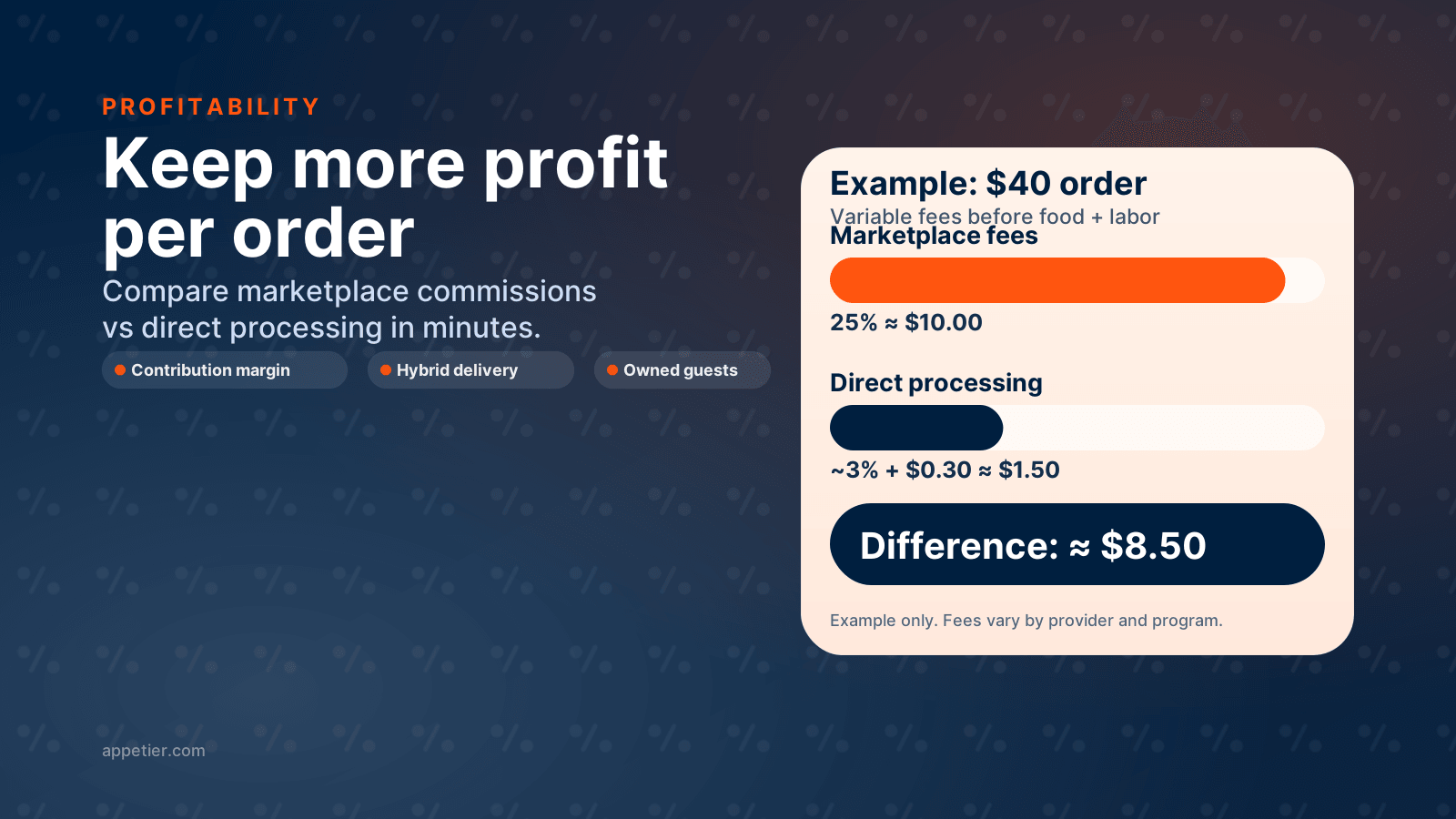
Here is a simplified example to show why repeat guests belong in your owned channel.
Example assumptions are illustrative. Actual marketplace fees and payment processing rates vary by provider, program, and payment mix.
- Marketplace model example: 25% fee on $40 leaves ≈ $30 before food and labor.
- Direct model example: ~3% + $0.30 processing on $40 leaves ≈ $38.50 before food and labor.
- That spread can fund loyalty rewards, better packaging, and faster service to drive repeat orders.
How to transition without losing marketplace volume
You do not need to flip a switch overnight. The best transitions protect discovery while steadily pulling repeat demand into your owned channel.
- Use marketplaces for discovery. Use your official ordering link for retention.
- Offer direct-only perks: loyalty points, free add-ons, exclusive bundles, early access specials.
- Promote direct ordering where you already win attention: receipts, bags, QR codes, email, SMS, Google Business posts.
- Tune channel strategy: avoid deep marketplace discounting that trains guests to only buy on promo.
Direct ordering checklist: quick wins this week
If you want more direct orders fast, focus on changes that reduce friction and increase repeat behavior.
- Make “Order Online” the primary website header CTA and update your Google Business ordering link.
- Add QR codes to pickup bags, delivery packaging, and receipts that point to your direct ordering page.
- Launch a simple loyalty offer for direct orders and trigger a reorder message 24 to 72 hours later.
- Track direct share of orders, repeat rate, and contribution margin by channel every week.
Commission-free ordering FAQs
A few common questions operators ask when comparing direct ordering against marketplace channels.
- Do I need to abandon marketplaces? No. Use them for discovery and push repeat guests to direct.
- What should I measure to decide? Contribution margin per order, repeat rate, and direct order share.
- What makes direct ordering actually work? Fast mobile checkout, clear official links everywhere, and loyalty + CRM tied to orders.
Want to see what this looks like for your brand?
Appetier connects commission-free direct ordering, loyalty + CRM, SEO automation, and POS sync so you can grow direct revenue and protect margin.
If you want, we can benchmark your current channel mix and map a transition plan that fits your locations and volume.
- Explore Online Ordering: /online-ordering
- Explore Loyalty: /loyalty
- Explore Restaurant SEO: /restaurant-seo
- Compare plans: /pricing
- Book a demo: /contact